Emile Zola was a French journalist whose article J'Accuse was of major importance in France at the end of the 19th Century, regarding the prosecution of an alleged army spy Alfred Dreyfus. His piece of work concerning this affair is a shining example to journalists regarding their power to shine light upon injustice.
Before explaining the affair itself, allow me to summarize the context of the time;
A number of years of tension between the French Empire and Prussia along with the other Germany states, culminated in the Franco-Prussian War in July 1870. The Battle of Sedan in Septmember 1870 was a comprehensive victory for Prussia and led to the eventual surrender of the French in May 1871.
After winning the war Prussia led a siege on Paris, forcing the provisional French government of the time to sign a humiliating treaty in Versailles, later known as the Treaty of Frankfurt. This forced France to pay huge war reparations and give up the Alsace-Lorraine territory to the soon to be unified Germany. To further add to the embarrassment Prussia would hold victory celebrations in Paris.
After Prussia had left France, the ordinary working class, fed up with the weak provisional government and sick of the high rent imposed upon them by their wealthy landlords led to a revolt in Paris - eventually leading to the establishment of the Paris Commune on March 18th 1871. The commune set up was based on socialist values; allowing workers to run businesses, the separation of church and state, the abolishment of night work and was also feminist sympathetic.
This 'communista' scared the French army and royalists - as well as much of Europe as it echoed many of Karl Marx's work and highlighted the 'spectre haunting Europe - the spectre of Communism'.
As a result of this the French Army decided to tear apart the commune. They flooded Paris and ruthlessly destroyed many working class areas - killing between 20-30,000 including women and children - although some suggest the death toll was actually higher! The Commune was effectively obsolete as of May 28th 1871.
It was short lived, but had a massive effective on European politics.
Now back to Zola and The Dreyfus Affair:
Following the humiliation of the Franco-Prussian War and Paris Commune France was in a 'hangover' state, with national identity at a low. Revenge against Germany became an obsession and they tried to build up respect again by creating an overseas Empire. particularly in Africa.
There was also a need to blame someone for the previous failures. There were many rumours of traitors in the army and much of the blame was laid on the Jews. This was furthered still when a business scandal at the Panama Canal showed certain Jewish businessmen had been taking bribes - Anti Semitism in France was flamed.
When important documents were discovered in the German embassy the France Army needed to find a scapegoat. Alfred Dreyfus was an intelligent and highly capable French Army captain, but as a Jew (in addition to hailing from the Alsace-Lorraine region) he fitted the bill for scapegoat perfectly.
The Army held a secret Court Marshall, finding him guilty of treason (despite bringing forward no evidence), stripping Dreyfus of his medals and exiling him to 'Devils Island' where he suffered all manner of neglect and cruelties.
An officer later looking into the case actually found evidence that a different man named Esterhazy was actually the guilty culprit - as his handwriting matched that found in the German Embassy, however despite the overwhelming evidence Esterhazy was acquitted in order for the Army to save face.
The trial was attended by French writer Emile Zola. On January 13th 1898 Zola published an open letter to the French President entitled 'J'Accuse' (I accuse).
Zola begins by paying his respects to the President - although he insinuates that history will remember who was in charge overall when re-visiting the Dreyfus Affair, which he describes as a stain on any French achievements. Zola describes the decision to acquit Esterhazy as a 'great blow to all truth' and effectively uses emotive writing throughout the piece to stress the importance of justice.
Zola dares to openly criticise those responsible for the cover up in the letter - stating that it is his 'duty to speak'. I think that this is something all journalists could learn from, we are effectively the eyes and ears of the public and as such I feel that there should be a large degree of honesty in our work - though this is clearly not always to case.
Zola sarcastically lists Dreyfus' ''crimes'' of being too ambitious, bright, calm and nervous. He uses this juxtaposition at the end to highlight the ridiculousness of the charges and to stress the unfairness of it all. Zola highlights the guilt of the officers who covered it up - ''they close mouths by disturbing hearts, by perverting spirits''. Zola considers this the greatest crime, showing that he was a keen believer in freedom of speech.
Zola outs those concerned with the wrongful framing of Dreyfus as anti Semites and adds that ''when society does this it falls into decay''. This shows signs of the desire for equality that the Paris Commune had potentially opened the doors for previously.
Zola criticises the media coverage of the trial. They, like him, must surely have seen the evidence and realised Dreyfus' innocence and yet chose to ignore this. He blames them for misleading the public and effectively fuelling bigotry. Zola emphasizes this by saying ''it is a crime to poison the small and humble, to exasperate passions of intolerance, a crime to exploit patriotism for hatred'' and adds ''if not cured France's liberal human rights will die''. This highlights the affect that the media can have in influencing the minds of the public - Zola is bluntly critical of the French media for promoting hatred of Dreyfus and Jewish citizens through their writing and by saying that France's liberal rights will die if this continues he is recalling the French revolution and its original cries for freedom.
Perhaps the most important part and J'Accuse is the conclusion. Zola clearly states the list of people who he blames for the wrong-doing in the Dreyfus Affair and gives his reasons why. The format of the text is laid out clearly in a list form so that Zola's accusations are blatent for all to see. Also Zola does not list Esterhazy in his accusations perhaps showing his obvious guilt by saying it isn't even worth exposing. He could also be highlighting the injustice committed by the state, showing that this was the worst crime.
Zola admits that he is aware of the trouble he may get in for doing so and acknowledges that he is potentially being libellous and guilty of slander. This is incredibly brave journalism, putting himself in the firing line in order to report truthfully and Zola's passion is clearly something to aspire to - he's something of a Saint or Superhero of journalism. The fact that this article led to him being convicted of libel and sentenced to prison before he managed to flee to London only enhances this reputation.
Zola saw his article as a catalyst for truth. His bravery could be seen to have been rewarded in that Dreyfus was awarded a secondary trial and despite being found guilty again this time there was massive outcry against the decision and he was eventually exonerated in 1906 after being pardoned four years earlier - although he was now a broken man.
When Zola died he was taken to the Pantheon to be buried, with Dreyfus present at the ceremony (where there was an assassination attempt of him!). I think that Zola deserved the accolade of being buried there as his work for justice and free speech in spite of a hostile situation is a noble cause and something that all journalists and writers should aspire to. Hero.
Wednesday, 18 May 2011

Monday, 9 May 2011
Super Injunction Superhero - Twitter user lists Injunction ''Celebrities''
Twitter user @Injunction Super has thrown a massive spanner in the carefully created machine of celebrity super injunctions by revealing the names of people who have recently taken out injunctions and listed the 'crimes' that they were so keen to hide.
These allegations include the premier league family man who had a six month affair with former Big Brother babe Imogen Thomas (though why he wanted to keep that secret is beyond me - I would've told anyone who'd listen), as well as other personal stories concerning some Z listeners that should be glad of the publicity.
Whether or not the user could be sued for libel or defamation remains to be seen, as this is effectively a ground breaking story - and one that highlights the ever increasing change that social networking sites are having on journalism. The papers are surely loving this development - the red tops will surely now be able to print the sexy pictures and stories of fame hungry home wreckers and the qualities will surely be able to write about their own brand of smut by criticising Andrew Marr - though I pray there wasn't a sex tape involved in his affair.
Whether or not the user could be sued for libel or defamation remains to be seen, as this is effectively a ground breaking story - and one that highlights the ever increasing change that social networking sites are having on journalism. The papers are surely loving this development - the red tops will surely now be able to print the sexy pictures and stories of fame hungry home wreckers and the qualities will surely be able to write about their own brand of smut by criticising Andrew Marr - though I pray there wasn't a sex tape involved in his affair.
Should we care about the private lives of these people? Probably not.
Will the recent media backlash against super injunctions benefit from this masked crusader? Probably.
Is this yet another example of how social networking is changing the face of Journalism? Definitely.
And whilst your @ it (see what I did there) follow me on http://twitter.com/#!/joshyboytyler - ignore the shameless attempts for a retweet - I might be a good journalist one day...
Will the recent media backlash against super injunctions benefit from this masked crusader? Probably.
Is this yet another example of how social networking is changing the face of Journalism? Definitely.
And whilst your @ it (see what I did there) follow me on http://twitter.com/#!/joshyboytyler - ignore the shameless attempts for a retweet - I might be a good journalist one day...
Tuesday, 3 May 2011
William Cobbett's Rural Rides - Seminar Notes
William Cobbett was born in 1763 in a rural area of Surrey. He spent 15 years in the army however his discovery that a senior officer was stealing army funds led to him being branded a trouble maker and he subsequently moved to France. On returning to England Cobbett started a Conservative newspaper ‘The Political Register’ in 1802 however he gradually began calling for more political reform and swayed towards the more radical movement. Cobbett’s views led to him spending two years in prison and he caused great opinion amongst the rich which we see in Rural Rides in regards to the many people who he lists as speaking unfavourably of him.
Rural Rides has a somewhat typically English start by mentioning the weather in the opening sentence ‘I set off, in rather a drizzling rain’.
Rural Rides has a somewhat typically English start by mentioning the weather in the opening sentence ‘I set off, in rather a drizzling rain’.
Cobbett set out to experience the countryside particularly farming areas – this could be as the industrial revolution was beginning and as a result farms and the country were perhaps becoming forgotten or deprioritised.
He is critical of those who are living of government hand outs under the poor laws of the time saying they have ‘every appearance of drinking gin’ and he may be suggesting that many of them are doing themselves no favours to improve their situation.
He mentions how at the Horse Fair cart colts are selling for less than a third of what they were 9 years before – I think that this could again show that perhaps the old methods of farming are beginning to be phased out and made redundant as machines became more prominent.
The Mr. Fox affair which Cobbett describes is critical of those in power, particularly Fox and implies that there was much greed and corruption amongst land owners which was unfair on the general public. Cobbett firmly outlines this in saying ‘such are the facts’ before inviting us to draw our own conclusion – something of a rhetorical question.
Cobbett calls for more political courage from landowners and politicians – he believes that many of them prevent reform and improvement by dismissing every new idea or reformer as ‘Jacobin’.
He blames lack of reform for ‘loan jobbers’, ‘stock jobbers’ and Jews gaining estates – Cobbett himself was anti-sematic.
Upon entering Chilworth Cobbett describes excellent farming conditions and the potential value of goods at market with great detail. As he was from a rural area himself and worked as a farm labourer as a young man he clearly has great nostalgia about the countryside – it could perhaps be suggested that ‘blind nostalgia’ is his main motive behind his criticisms of industrialisation. The embodiment of this nostalgia could be seen in his great love and admiration of the English oak tree.
Cobbett describes the public as the ‘generous landlord’ and implies that the rich themselves are not generous – that is why they remain rich. He calls for a reformed parliament in order to manage the public’s affairs better, though he seems to have little faith that this will happen as the ‘snug corporations’ and rich tenants tend to be the politicians as well and therefore it is in their interests to keep the poor, poor.
Upon entering Winchester Cobbett says that amongst labouring people the first thing to look for is honesty. This however, is something that cannot be expected of them unless their bellys are full and they are free from fear – this must come however from them earning wages and not from government hand outs. Cobbett again calls for the powerful to use their influence to prevent wage diminution of labourers – to be politically brave and call for reform.
In Winchester Cobbett has a dinner meeting with some of the local farmers. He says that the wealth of the church – and the wealth it bestows upon its ministers, in addition to the relief the government gives to the poor clergy despite the churches wealth is a clear example of why the current system must be reformed and changed.
Cobbett calls on the middle classes to aid the poor in taking the lead in demanding parliamentary reform.
Cobbett is also critical of the new barracks and houses that sprang up on his travels. He felt that they were not created out of a desire to help the poor and were not paid for by money – but created by labour – and the labourers were not appropriately rewarded for their efforts.
Cobbett describes the kindness that he is shown in Reading in particular and I think that this may well show that there is a certain union among the people in that they agree with many of his beliefs. This kindness is given despite the government and land owners determination to keep Cobbett out of parliament and to keep him down and this was something that seemed to spur Cobbett on throughout his travels.
Cobbett has clear dislike of taxes and this is shown when he hires a man to guide him from Hampshire into Surrey ensuring that he avoided the turnpike at Hindhead – as to use this he would have been taxed. However, the guide got lost and Cobbett ended up having to pay the tax – though he refused to pay the guide – showing again that he had a disregard for charity and felt that wages should be earnt.
Cobbett was also clearly opposed to those in beaurocratic jobs – who he calls tax eaters. This is something that is perhaps still relevant today – with many local councils and civil servants losing or having their jobs readjusted in the government cuts.
Cobbetts criticism of the Corn Laws which came in in 1815 are clear throughout the book. He seemed to suggest that this created farmers who became gentleman and as a result their workers became more like slaves. The initiative to ‘Buy British’ that the Corn Laws created meant that there was overproduction of goods in some years, despite the expanding population – as a result of this prices of crops were forced down and therefore farmers made less money than before – Cobbett is critical of this as it widen the gap between the rich and the poor.
Cobbett outlines his belief that the old system was better than the new, industrialisation whilst journeying towards Bath, when he says that ‘any man of sense feels our inferiority to his fathers’. I feel that in this aspect Cobbett is somewhat short sighted with regards to industrialisation. He appears to not see it as beneficial in any way and with hindsight I would argue that it brought many great inventions and even wealth to the British Empire – though Cobbett’s calls for this wealth to be more evenly and fairly distributed given the poverty many endured during this time is of course a very valid point.
In Tutbury Cobbett describes meeting a man who asks if he has seen a poor old man – as he is wanted for stealing cabbages from a landowners’ garden. Cobbett’s anger that this poor old man is wanted for this shows consistency with his earlier sentiment that you cannot expect a poor man to be honest if he is starving. This is an example of the consistency of opinion that Cobbett shows throughout Rural Rides and I think that to his credit he shows little or no hypocrisy of opinion throughout the book.
Cobbett shows a great sympathy and respect towards the Irish. He criticises those who are against Irish immigrants as he believes that they are a people willing to work. He instead describes the Scotch as ‘tax eaters’ (perhaps in retaliation to those whose call him a Jacobin).
Cobbett finishes his travel guide by praising the benefits of sobriety, early rising and firm resolution – something that he claims to have shown throughout his trip. This is effectively a summary of his belief in a hard-working, agricultural Britain, where such efforts and labours are rewarded.
Overall, figures such as Charles Dicken’s work and effect on British cities are perhaps better remembered, though no more valiant than Cobbett’s in the countryside. I would argue that this was perhaps Dicken’s created much more exciting and enjoyable stories. Cobbett’s journey in Rural Rides was clearly an eventful one with many hardships and astute observations made along the way however, I found it slightly tedious and his obsession with the quality of the soil and tendency to waffle on are perhaps the main reason why the book is not as widely heard of as many of Dickens’ works. It could be argued that Cobbett was trying to take things back through his reforms whereas Dickens sought to move forward – Cobbett fondness for nostalgia certainly suggests this, As well as this Dickens wrote about an expanding population in the cities, whereas Cobbett was appealing and writing about those in the countryside – an increasingly emptying area.
Cobbett could perhaps be compared in some ways to Darwin. Darwin was a great believer in travel and exploring the world for himself enabled him to form his theories on evolution. Similarly Cobbett should be praised for getting amongst the problems in the countryside and experiencing them for themselves in order to formulate his opinions and solutions. This notion that we learn through experience is also present in the theories of Locke’s Tabula rasa and much of the Empiricist movement – though his love of the countryside also mirrors Rousseau’s love of nature.
Wednesday, 27 April 2011
Radio Script
1. Unemployment:
Almost one million young people are unemployed, the latest national office figures have announced. The number of jobless 16-24 year olds lept by 66,000 in the three months of 2010 - the biggest unemployment slump since World War Two.
Of the 210,000 jobs created by the government last year, 82% were given to people born outside of the UK, mainly those from Eastern European nations.
End time: 0'26
2. Beggars:
The number of beggars in Winchester City Centre that are acting as buskers to get around County laws, is becoming a major problem. We spoke to PCSO Helen Carthew:
Audio clip Helen Carthew 0'25
3. Social Care:
Plans to increase the maximum weekly expensive for adults requiring domestic social care to 100% of their net income have been rejected by Hampshire County Council. The maximum charge will now remain at 95%. Similarly a proposal to charge the carers themselves was also rejected after a survey showed 75% of the public disagreed.
Almost one million young people are unemployed, the latest national office figures have announced. The number of jobless 16-24 year olds lept by 66,000 in the three months of 2010 - the biggest unemployment slump since World War Two.
Of the 210,000 jobs created by the government last year, 82% were given to people born outside of the UK, mainly those from Eastern European nations.
End time: 0'26
2. Beggars:
The number of beggars in Winchester City Centre that are acting as buskers to get around County laws, is becoming a major problem. We spoke to PCSO Helen Carthew:
Audio clip Helen Carthew 0'25
3. Social Care:
Plans to increase the maximum weekly expensive for adults requiring domestic social care to 100% of their net income have been rejected by Hampshire County Council. The maximum charge will now remain at 95%. Similarly a proposal to charge the carers themselves was also rejected after a survey showed 75% of the public disagreed.
Tuesday, 5 April 2011
Radio News Bulletin
Here's the youtube link for my Radio News Bulletin, featuring reports on young unemployment levels, Winchester's problems with beggars and news on the Council's proposals to change its social benefit system.
Due to my technological ineptitude I also have one other story on the Winchester Tourism Boards nomination for a National award, which I will try to put up as soon as I can.
To hear the bulletin visit http://www.youtube.com/watch?v=JMyPhWWMuEw
Due to my technological ineptitude I also have one other story on the Winchester Tourism Boards nomination for a National award, which I will try to put up as soon as I can.
To hear the bulletin visit http://www.youtube.com/watch?v=JMyPhWWMuEw
Sunday, 20 March 2011
Karl Marx
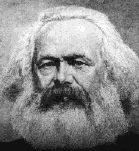 Karl Marx, 1818 - 1883 was a German philosopher and political theorist who is considered the father of Communism.
Marx originally studied law and then philosophy before becoming interested in revolution. He was a journalist and editor for many radical newspapers across Europe, however his revolutionary ideas led to him being forced out of many countries before he settled in London, where he stayed until his death.

Many of Marx's theories appear to have been influenced by Hegel, though he dismissed and changed many of Hegel's ideas. The Hegelian theory of the dialectic is clearly the one with which Marx is most concerned with. As I have previously explained http://josh-tyler.blogspot.com/2011/03/georg-wilhelm-friedrich-hegel.html, Hegel felt that change occurred when one idea (the thesis) was contradicted by another (the antithesis) to create a new idea - the synthesis. Marx liked this idea as a way for history to progress, however, whereas Hegel believed that history was guided by a 'geist' spirit towards an absolute end, Marx believed it was more practical and political, dismissing Hegel's idea as idealist nonsense.
Marx saw the real dialectic not as a geist, but in economic life, particularly in class struggle. His theory of history is therefore known as 'Dialectic Materialism'. Indeed in changing Hegel's key philosophy (as well as disagreeing with his love of the state and belief in God) Marx demonstrates his belief in using other ideas as only an outline to create your own: 'the philosophers have only interpreted the world - the point however, is to change it'.
The idea of class struggle is the main driving force of the Communist Manifesto. Marx outlined that society was now separated into two classes; the working Proletariat and the Bourgeois. He believed that though the Bourgeois were in themselves a revolutionary force, they did so solely for capital and greed, turning all professionals into mere paid wage labourers. He criticised globalisation and industrialisation for placing property and ownership into just a few wealthy hands and as a result creating political centralisation of power.
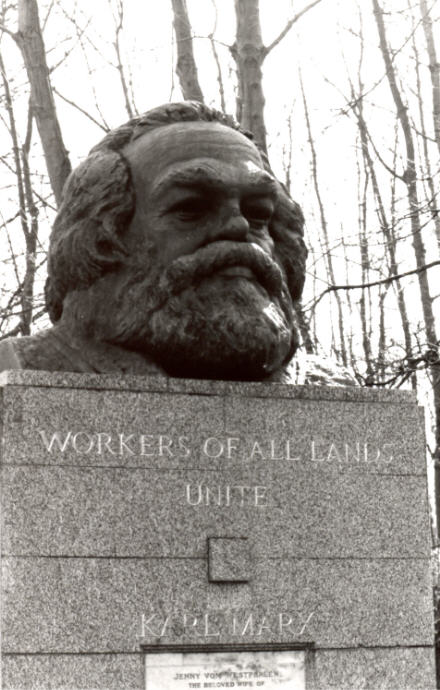
This society, with all its new machinery and processes reduced the lower middle class to working class and as a result united the low paid worker, creating a more unified Proletariat. Marx actually has 'workers of the world, unite' on his tombstone. Marx felt that this was a clear example that capitalist society and the Bourgeois who created it were doomed to fail and were simply 'digging their own graves'. As the Proletariat had nothing to lose and everything to gain, it was they who could act as the antitheses of the dialectic and drive change in, Marx saw this change as socialism and eventually Communism. Marx envisioned this as a society of equality, justice and the fulfilment of a truly free individual.
Marx outlines in The Communist Manifesto ten main policies that the Communist party would enforce;
1. Abolition of Private Property
2. A heavy graduated income tax
3. Abolition of inheritance right
4. Confiscation of rebel and emigrant property
5. Centralisation of banks
6. Centralisation of transport
7. Extension of factories
8. Combine agriculture with manufacture (to establish a more balanced difference between cities and countryside)
9. Equal obligation of all to work
10. Free education for all children and abolition of child labour.
Once this measures were in place Marx believed that class distinctions would disappear and the public would lose its political character. This would mean that the dictatorship of the proletariat (a socialist process that Marx felt was necessary for the laws to be implemented) would become redundant.
After this a free and equal society would prevail, a society where man was not alienated from one another, were we value each other over gain and possessions and behaved From each according to his ability, to each according to his need.
The manifesto ends with a Rousseau inspired slogan to encourage the working class to rise up and end the oppression of the Bourgeois:
Let the ruling classes tremble at a Communist revolution. The proletarians having nothing to lose but their chains.
Wednesday, 9 March 2011
Georg Wilhelm Friedrich Hegel
Hegel was a German philosopher who lived from 1770 to 1831 and is often credited as the culmination of the German idealist movement that began with Kant.

Hegel had a belief in the unreality of separate parts. He felt that nothing was completely real except the 'whole' and saw everything as a complex system that could only be considered when seen as a whole. He felt that 'whatever is, is right'. Hegel refers to the whole as the 'absolute' and considers it spiritual. As a result of this it appears that God is the absolute, a pure being.
Hegel's view on spirituality is an interesting one, that comes from his idea of the 'dialectic'. Hegel believed that everything had a thesis (a proposition) and an antithesis (contradictions to this). The result of these two ideas led to the Synthesis - a combination of opposing points of view that in turn created a new idea. When linking this to his idea of spirituality, Hegel believed that we as humans moved towards the 'absolute, pure being' (God) through a series of dialectic transitions. He referred to these periods of transition as 'geists' and suggested that these were guided by an external force rather than through our own actions. Hegel believed that we will become an absolute being once we have self knowledge of our spirit.
Hegel's political views were also based upon his dialectic theory. He thought that world history repeated the transitions of the dialectic and that it too was guided by a geist in moving towards an eventual end. Using War, for example helps to explain Hegel's theory. If we consider one nation as the thesis and one as the antithesis, the result of the conflict would be the synthesis - and this is how change occurs throughout history.
Hegel was a great lover of change however there does appear to be some contradictions in his own political beliefs. In his later life he was very pro-German, however he was also a great supporter of Napoleon and was said to have welcomed his defeat of the Prussian army.
Hegel's glorification of the state in his later life could also be seen as a contradiction. He felt he was a great lover of change and freedom, however he also felt that there was more freedom to be found in a monarchist rule than in a democracy. This would suggest that he was both a lover of freedom and obeying the law, Bertrand Russell describes this contradiction perfectly by arguing that what Hegel really believed in was 'the freedom to obey'.
Hegel's theory leads nicely on to my next History and Context of Journalism study - that of Karl Marx. Marx's relationship with Hegel's theories appears to be an interesting on, with Marx dismissing Hegel's views on the hidden geists as idealist nonsense, but appearing to agree with Hegel's theory of the dialectic as a process to drive change and he perhaps applied this theory in a much more realistic and empirical way than the ideals of Hegel .
Wednesday, 2 March 2011
Comb Overs and Cricket - Hampshire County Council Meeting
The old saying 'a camel is a horse designed by committee' is one which I wholeheartedly agree with. As a result of this I was somewhat sceptical about sitting in on the latest Hampshire County Council meeting, lavishly held in the grounds of Winchester's Great Hall. Indeed this feeling was somewhat increased upon seeing the selection of councillors entrusted with the decision making of the county, without wishing to be unkind they could all be found queueing in the post office on a Thursday morning. I wouldn't like to guess at the total age of the predominantly male council but 1,204 wouldn't be far off. The original conversations that I overheard concerned stereotypical comments on cricket and the weather. Given that 'broadband' was also on the agenda I questioned how much knowledge the room would possess on this, especially as there were technical issues from the start and the speaker questioned why his voice was 'so echoey' after inadvertantly turning his microphone on.
The first issue discussed (and at over an hour in great detail), was 'The Contribution Policy for Adult Social Care'. The proposal was to adapt the current system in order to consider each case individually, potentially leading to 1/3 of disabled adults having to pay more for social care (although 40% would still pay nothing). It was agreed that the maximum weekly charged of £440 per week be removed whilst plans to raise the expense to 100% of net income and charge carers for their service were rightly rejected.
After this came the discussion on improving broadband in the Hampshire area. Far from being the technological neanderthals I was expecting - most of the council proved to have a detailed knowledge on 'computers' with one gentleman even flashing an i-phone and all agreeing that faster broadband should be provided in rural areas.
The next item on the agenda was a brief discussion on the budget, with special emphasis on the expense of gritting the roads during the snowy weather and the financial costs of restoring the Gosport village green. The meeting was then over for us as the next item was not available for public viewing - stirring up all sorts of images of what was being discussed.
In all seriousness however, the people at the Council were very welcoming, giving us a tour around the building, refreshments and ensuring that everything that was discussed was explained so that we could understand and I would like to thank them for their generosity.
The first issue discussed (and at over an hour in great detail), was 'The Contribution Policy for Adult Social Care'. The proposal was to adapt the current system in order to consider each case individually, potentially leading to 1/3 of disabled adults having to pay more for social care (although 40% would still pay nothing). It was agreed that the maximum weekly charged of £440 per week be removed whilst plans to raise the expense to 100% of net income and charge carers for their service were rightly rejected.
After this came the discussion on improving broadband in the Hampshire area. Far from being the technological neanderthals I was expecting - most of the council proved to have a detailed knowledge on 'computers' with one gentleman even flashing an i-phone and all agreeing that faster broadband should be provided in rural areas.
The next item on the agenda was a brief discussion on the budget, with special emphasis on the expense of gritting the roads during the snowy weather and the financial costs of restoring the Gosport village green. The meeting was then over for us as the next item was not available for public viewing - stirring up all sorts of images of what was being discussed.
In all seriousness however, the people at the Council were very welcoming, giving us a tour around the building, refreshments and ensuring that everything that was discussed was explained so that we could understand and I would like to thank them for their generosity.
Wednesday, 23 February 2011
Churnalism
We're all pretty familiar with all the rubbish newspapers often churn out. As something of a warning to my fellow students I found this website www.churnalism.com that basically exposes lazy journalists who simply copy stories from press releases without adding much to it at all and then pass it off as their own work (something we would never do of course - I'm often amazed at how often wikipedia copied my homework).
On the site you type in the story you've read and it shows you how much of it was from a certain press release and therefore how much of their own input the journalism has included.
http://churnalism.com/
On the site you type in the story you've read and it shows you how much of it was from a certain press release and therefore how much of their own input the journalism has included.
http://churnalism.com/
Thursday, 17 February 2011
Mary Wollstonecraft
Mary Wollstonecraft was a British writer and philosopher who lived between 1759 and 1797. Her many writings on the role of women in society have led her to be considered in some circles as 'The Mother of Feminism'.


Wollstonecraft's most famous piece of work was 'A Vindication of the Rights of Woman' which was published in 1792. As part of my history and context of journalism module we considered chapter 4 of this book, 'Observations on the state of degradation to which woman is reduced by various causes' (yes, her style is this unnecessarily long-winded throughout!).
Wollstonecraft's main problem with the female perception of society appears to be the courteous way in which the men of this period treated them. This may seem a strange argument at first, however Wollstonecraft explains that this politeness is merely 'hollow respect' and is limiting female instinct and potential. She uses a the wonderful imagery of a bird in cage to describe this, adding that all women have to do is remain in the cage and plume their feathers. This suggests that Wollstonecraft felt that although chivalrous treatment may make a woman feel special, it is merely another example of men exerting dominance and is condescending. This is extended further in the example of a man holding a door open for a woman, the woman could easily do it for herself and therefore this is yet another example of men showing physical dominance. Wollstonecraft suggests that women could be as strong as men, its just society and a lack of willingness preventing them. This appears to be her most prominent criticism of women - they are simply not doing enough for themselves. Indeed the way she launches this attack almost makes it hard to believe that the author herself is female.
Wollstonecraft's solution to these problems is education. This lack of education places women in a pigeon hole and as a result little can be expected of them. Wollstonecraft seems to criticise the male use of education, stating that they see it merely as a 'practical guide to life' rather than the first step to advancement. Indeed that Wollstonecraft was effectively self-educated, having been a great reader, shows that she saw the potential of education in the expansion of our minds, rather than simply learning how to do what you're taught. She adds that men are prepared for profession, whilst women are prepared for marriage, suggesting that whilst pleasure is the main business of a woman's life they cannot advance in society. She quotes Rousseau in this passage (someone who's theories she appears to have a hot and cold attitude towards) in stating 'educate women like men and they will have less power over us'. I think Wollstonecraft disagrees with this - she does not want women to have power over men (indeed any power they did have was shallow), but for them to have power over themselves. Her ideas are similar in some way to a great 'equaliser' from the enlightenment John Locke (though how much equality his ideas really had is open for debate). Wollstonecraft's ideas remind me of Locke's blank slate - her belief that education was key suggests that she too felt we were all born equal and can only improve ourselves by experiencing and learning new things.
Wollstonecraft compares female attitudes at the time as similar to someone who is born rich. They have no real need to use their brains or have any talent as their role in society is a superficial one. She seems to favour the hardships of the 'middle rank of man', suggesting that these men are of the most virtue. Wollstonecraft also praises the direction that they have, always something to work towards, something to achieve. This is clearly an attitude she feels is lost on the rich, and something women need to adopt. She adds that 'a King is always a King and a woman is always a woman' which suggests that the ordinary man can be whatever he wants. She feels that if more women had a more direct attitude then there would be less of a distinction between man and woman. She does not want women to be seen as 'heroines or brutes' but simply reasonable creatures.
Wollstonecraft was fascinated by the French Revolution which began in 1789. Louis 14th (see image) is a prime example of her attitude towards the rich. He is described as a model Prince who no doubt lived for the extravagant manners and flair that typified the aristocracy at this time. She believed that as a result of this the nation suffered. She would have been excited by the revolution and its 'we the people' motto which suggested equality amongst all.


Strangely Wollstonecraft also seemed to have been something of a Romantic, often advocating the benefits of love. The only time where she felt there should be a gender distinction was in a loving relationship. In Chapter 4 she describes her dislike of Polygamy stating that there is no practical positives to it and nature intended man to have one wife. She adds that a faithful woman demands respect. I think that this aspect of Wollstoncrafts theory is somewhat hypocritical considering her private life. She seemed to fall in love hard and was romantically linked with several men including artist Henry Fuseli, American adventurer Gilbert Imlay (and was registered as his wife in France) and British philosopher William Godwin (who fathered daughter Mary Shelley future author of Frankenstein). Wollstonecrafts chaotic love-life included two failed suicide attempts and it is this image that has perhaps hampered her reputation amongst some feminist groups. Indeed it is hard to take her views on Polygamy seriously for example, as she apparently once proposed a platonic, polygamous relationship to Fuseli and his wife.
Despite this controversy however I think that Wollstonecraft does raise some interesting ideas. Her strong belief in education as key to advancement is something that I wholeheartedly agree with and her preference towards the middle man and belief that they have more direction and ambition is something I can also relate to. There can be no doubt that she played a vital role in the advancement of women in society and I think that she perhaps deserves more prominent recognition in the feminist movement as she was clearly a strong woman who led by example to show women how to achieve equality.
Despite this controversy however I think that Wollstonecraft does raise some interesting ideas. Her strong belief in education as key to advancement is something that I wholeheartedly agree with and her preference towards the middle man and belief that they have more direction and ambition is something I can also relate to. There can be no doubt that she played a vital role in the advancement of women in society and I think that she perhaps deserves more prominent recognition in the feminist movement as she was clearly a strong woman who led by example to show women how to achieve equality.
Friday, 24 December 2010
Friday, 3 December 2010
Jonathan Swift's Modest Proposal
Jonathan Swift was an Irish satirist, essayist and political writer who was born in 1667.

Although he is perhaps best known for his novel 'Gulliver's Travels' the piece of Swift's work that I looked at was his satirical essay written 1729 entitled 'A Modest Proposal'.
Swift begins this essay by outlining his 'great intentions' to help the poor people of Ireland. The exaggerated grandeur of such language was undoubtedly a subversive mocking of Empiricist writing, as it is very similar to the pompous tone used by followers of this school such as Locke.
Swift highlights the plight of the poor and emphasizes the need to find a cheap and fair way to help them, help themselves. Swifts ingenious idea to achieve this is for Irish people to start eating babies.
Under this plan, Swift says that as children are not of much value to their parents anyway and are expensive to raise, selling a child between the ages of 1 and 2 when, according to his 'American friend' (a narrative trick Addision also used) they are at their most delicious as a luxurious food, would bring in income for poorer families and save them the money on raising the child anyway.
 Swift outlines a number of surprisingly convincing advantages of this proposal. The first point he lists is that it would lower the number of Papists, who he implies breed too much as it is. This humorous attack on Catholicism was very in keeping with the general attitude of many at this time as it was widely believed that they could not be trusted and harboured allegiances abroad.
Swift proposes that selling their babies to the rich would also mean that the poor had something valuable to trade with that would both make and save them money.
He adds that taverns would also benefit, famine would decrease, the economy would improve and debt and poverty would be reduced as a result of this scheme.
My favourite of Swifts advantages for his proposal however, is that it would prevent men from abusing their pregnant wives by methods such as kicking them in the stomach, as they would not want to risk harming their unborn money-making child. Swift seems very anti-abortion and this plan would mean that such a practise would also be made redundant.
Although from a modern day perspective this cannibalism seems inhumane, I couldn't help but think that economically speaking Swifts proposal made a lot of sense. Indeed considering the hunger and suffering that the poor endured during this period in Ireland, his argument that the children would be saved from a life of misfortune and pain anyway makes his idea sound somewhat kind. The essay is so well written that Swift makes an idea that when first heard seem so far-fetched appear very reasonable. This is due to the brilliance of his satire of Empiricist style writers and his economically accurate and logical hypotheses.
So good in fact, that I'm contemplating how much my new-born niece would fetch on the black market......and whether she'd taste good with gravy.
Click here for a great 'rap' video summarizing Swift's Proposal - http://www.youtube.com/watch?v=Yf0LH8FtHAc
Although he is perhaps best known for his novel 'Gulliver's Travels' the piece of Swift's work that I looked at was his satirical essay written 1729 entitled 'A Modest Proposal'.
Swift begins this essay by outlining his 'great intentions' to help the poor people of Ireland. The exaggerated grandeur of such language was undoubtedly a subversive mocking of Empiricist writing, as it is very similar to the pompous tone used by followers of this school such as Locke.
Swift highlights the plight of the poor and emphasizes the need to find a cheap and fair way to help them, help themselves. Swifts ingenious idea to achieve this is for Irish people to start eating babies.
Under this plan, Swift says that as children are not of much value to their parents anyway and are expensive to raise, selling a child between the ages of 1 and 2 when, according to his 'American friend' (a narrative trick Addision also used) they are at their most delicious as a luxurious food, would bring in income for poorer families and save them the money on raising the child anyway.
Swift proposes that selling their babies to the rich would also mean that the poor had something valuable to trade with that would both make and save them money.
He adds that taverns would also benefit, famine would decrease, the economy would improve and debt and poverty would be reduced as a result of this scheme.
My favourite of Swifts advantages for his proposal however, is that it would prevent men from abusing their pregnant wives by methods such as kicking them in the stomach, as they would not want to risk harming their unborn money-making child. Swift seems very anti-abortion and this plan would mean that such a practise would also be made redundant.
Although from a modern day perspective this cannibalism seems inhumane, I couldn't help but think that economically speaking Swifts proposal made a lot of sense. Indeed considering the hunger and suffering that the poor endured during this period in Ireland, his argument that the children would be saved from a life of misfortune and pain anyway makes his idea sound somewhat kind. The essay is so well written that Swift makes an idea that when first heard seem so far-fetched appear very reasonable. This is due to the brilliance of his satire of Empiricist style writers and his economically accurate and logical hypotheses.
So good in fact, that I'm contemplating how much my new-born niece would fetch on the black market......and whether she'd taste good with gravy.
Click here for a great 'rap' video summarizing Swift's Proposal - http://www.youtube.com/watch?v=Yf0LH8FtHAc
Friday, 26 November 2010
The Daily Telegraph and Radio 1 Newsbeat
As part of my latest presentation, I looked at the News Agenda of The Daily Telegraph and Radio 1.

The Daily Telegraph features a World News section towards the back middle pages of the paper. I was surprised at how far back many of these world affair stories were published as they were often important reports including violence in the Middle East and the G20 summit. Even further towards the back is the Comments and Features section, where feature writers and special guests write much more in depth pieces. There is also a significantly sized letters to the editor area in this section.
The Telegraph has the oldest average readership of any national paper and on average it takes fifty-six minutes to read. This suggests to me that The Telegraph is mainly targeted at someone with more time to spare reading the news, and its high age of readers suggests many of them will be retired. The Telegraph can therefore afford to feature longer articles and features as it understands that many of its readers can afford the time to view them.


Most Newsbeat episodes feature entertainment news, usually with at least one celebrity interview. In addition to this there is usually one story featuring education based events as a result of their target audience. Recently for example, stories about the rise in tuition fees have featured and are very pro-student biased. In contrast to this The Telegraph was very critical of lecturers who took part in and praised the recent protests.
The Daily Telegraph was founded in June 1855 by Colonel Arthur B. Sleigh, an army officer and travel writer. It was originally published to air Sleigh’s complaints about the Duke of Cambridge and to expose what Sleigh saw as the truth of the Crimean War. The paper was not a success however and as a result Sleigh was forced to sell it to his publisher Joseph Levy. Levy was experienced in this field as he was involved with other newspapers around at this time and he decided to launch the Telegraph as a cheaper alternative to those already on the market. His sons who succeeded him later coined the slogan ‘the largest, best, and cheapest newspaper in the world’.
Nowadays, however, the Telegraph is owned by identical twin brothers, Sirs David and Frederick Barclay, who made their £1.8billion fortune in a variety of businesses including hotels, casinos and department shops. They purchased the Telegraph and its sister companies in 2004 from a Canadian business for around £665m. Their time in charge has been somewhat ruthless and eventful with one hundred journalists made redundant in 2006 and a further seven editorial changes to the Sunday and Daily Telegraph since their ownership began.
The Daily Telegraph is traditionally considered to have a right-of-centre political alignment and as a result has conventionally been considered pro-Conservative Party. Its affiliation with Tory leaders actually led to Private Eye magazine dubbing it ‘The Torygraph’. There is some suggestion however, that under the Barclay brothers the Telegraph is eager to move away from being associated as 100% Tory. In a recent interview David Barclay stated that the Telegraph would not be ‘the house paper of the Conservatives’ adding that ‘where the government are right, we shall support them’. Despite this I believe the Daily Telegraph to still be a centre-right newspaper. I have found numerous references to this relationship in my recent reading, from subtle quotes such as ‘targets concerning waiting times and cancelled operation, introduced by Labour, result in managers pushing Doctors’, showing a desire to emphasize blame on the previous Labour government. There was also some more obvious pro-Conservative content featured, such as the headline ‘Mrs. Thatcher was right’. I think that Barclay’s statement regarding The Telegraph’s political persuasion was a somewhat pragmatic comment on his behalf. He may well have wanted to avoid the paper being completely associated with the current government as if they were to prove unpopular, the newspapers sales would be likely to dip.

The Daily Telegraph itself usually has something of a busy front page layout. The ‘Win Free Sex’ box at the top of the paper is not as crudely obvious as many of the tabloids often are, but it is often brightly coloured, advertising promotional give-a-ways or articles from feature writers.
The main headlines of the day of course feature on the front, and are usually politically based, rather than entertainment news for example. There are usually three or four main stories on the front page, each with a reasonably large section of reporting and this is again in contrast with the one story front page approach favoured by the tabloid and mid-market papers.
The main headlines of the day of course feature on the front, and are usually politically based, rather than entertainment news for example. There are usually three or four main stories on the front page, each with a reasonably large section of reporting and this is again in contrast with the one story front page approach favoured by the tabloid and mid-market papers.
Along the right hand side of the second page runs a news in brief column which features short bulletins of both serious and light-hearted stories.
The Daily Telegraph features a World News section towards the back middle pages of the paper. I was surprised at how far back many of these world affair stories were published as they were often important reports including violence in the Middle East and the G20 summit. Even further towards the back is the Comments and Features section, where feature writers and special guests write much more in depth pieces. There is also a significantly sized letters to the editor area in this section.
The Daily Telegraph describes its target audience in its online rate card as being affluent, loyal, influential and elusive. This claim of loyalty appears to be justified as 81% of their readers look at no other daily quality.
The Telegraph has the oldest average readership of any national paper and on average it takes fifty-six minutes to read. This suggests to me that The Telegraph is mainly targeted at someone with more time to spare reading the news, and its high age of readers suggests many of them will be retired. The Telegraph can therefore afford to feature longer articles and features as it understands that many of its readers can afford the time to view them.
In terms of social groups 59% of the Daily Telegraph’s readers are AB1. This means that they are upper and middle class with a further 28% lower middle Class. This would imply that the vast majority of Telegraph readers are wealthy and well educated. As a result of this the Telegraph can use different language and more complex sentences than a tabloid paper. The Plymouth University’s guide to working out a reading age shows that the Telegraph use an average reading age of a nineteen year old whilst The Sun’s is that of a twelve year old.
The Daily Telegraph also has a 56% male majority of readers. One example that I regularly found which may show their awareness of this was that more often than not the front page featured a photograph of an attractive woman. These women tended to be more culturally high-brow than say Cheryl Cole for example (and usually in less sexually suggestive poses), but including these images may be a deliberate acknowledgement of their male majority audience.

The adverts featured in the newspaper also tell us much about their audience. I found that the brands of car and watch that are often advertised were usually at the reasonably high-end of the market, with Audi in particular embarking on an almost daily campaign. Similarly the supermarkets that advertised in the Daily Telegraph were Waitrose, Marks & Spencer’s, Tesco’s and Sainsbury’s, highlighting the Telegraph’s predominately middle-class audience, as cheaper brands such as Aldi or Lidl did not.

The Daily Telegraph is the bestselling quality daily with an average circulation of 678,252 between April and September 2010, according to the Audit Bureau of Circulation. This is estimated to mean they have around 1.8m readers (National Readership Survey). This circulation is 35% more than the nearest daily rival The Times and amounts to 43% of the quality market. Despite this, in keeping with the general decline of newspapers, sales for The Telegraph are down by around 2.5% in the last year and nearly double that in the last five years.
With other former broadsheet newspapers such as The Times deciding to change their broadsheet format to something smaller, it is interesting that The Daily Telegraph did not. One possible reason for this could be to ensure that it still stands out. Given that all the other daily qualities now use a smaller format I believe that this is certainly a valid point. I also think that given the older nature of their main readers, many will be retired and therefore can spare the time and space to unfurl the paper over their table. Also given the great emphasis on loyalty that the Telegraph places on its audience, they may have been reluctant to change this particular area, despite making technological innovation with other aspects.

The Telegraph launched its online version in 1994, becoming the first daily web-based newspaper in Europe to do so. www.telegraph.co.uk is now in the top 3 most popular UK newspaper websites, receiving an average of 1,669,773 unique browsers a day, each spending roughly thirteen minutes on the site. Though The Telegraph had fallen somewhat behind online in recent years, its exposure of the MP’s Expenses Scandal has seen it climb back up in the last eighteen months.
I will now look to compare The Daily Telegraph with Radio 1’s own news coverage.
BBC Radio 1 was launched in 1967 in an attempt to modernize the BBC’s radio coverage. Its use of jingles was also a BBC first and was an attempt to attract the young listeners who previously had often listened to ‘pirate’ radio stations such as Radio Caroline, that had recently been outlawed.
Radio 1 has a public service broadcasting obligation to provide news, under Ofcom regulations, as it is an organisation intended for public benefit rather than purely commercial reasons. The result of these restrictions is Newsbeat, Radio 1’s flagship news programme. It began in 1973 and was a response to the less traditional news bulletins that were popular on commercial radio stations at this time, making it very different from the formal, old-fashioned style of BBC Radio’s news reporting.
Nowadays Newsbeat is broadcast at 12.45 and 17.45 during the week, lasting for around 15minutes, with shorter bulletins played throughout the day every thirty minutes. This is structurally the complete opposite to The Telegraph, which has a lengthy average reading time and as a result reports each story in much more depth.
Newsbeat tends to open by outlining the stories it intends to discuss, with brief snippets of upcoming reports and interviews. The various regulations imposed ensure that it too must provide important political stories; however it often features basic question and answer style information to explain more complex reports. In addition to this nearly every report tends to feature interviews with the general public asking for their opinions. This is a clear contrast to The Telegraph, where the readers own thoughts are located near the back, taking up just half a page.
Most Newsbeat episodes feature entertainment news, usually with at least one celebrity interview. In addition to this there is usually one story featuring education based events as a result of their target audience. Recently for example, stories about the rise in tuition fees have featured and are very pro-student biased. In contrast to this The Telegraph was very critical of lecturers who took part in and praised the recent protests.
The tone of Newsbeat is very informal. The language used is a clear representation of this. One person interviewed used the word ‘crappy’ in the broadcast and this is something that I would not expect to find on any of the other BBC news programmes. Presenters and reporters talk to each other colloquially as well with one example being where the main presenter linked to the next reporting by saying ‘Alright Dave’. This is yet another contrast to The Daily Telegraph as we have already seen that they have the highest readership age of the national newspapers.
There is music played throughout Newsbeat, rather than just at the beginning or end of the broadcast. This emphasises that Radio 1 is a predominately music based channel and could also be used to keep their target audience interested during the news break.
These examples of tone and content clearly show that they are aiming at younger listeners and indeed their target audience age is between fifteen and twenty-four. The BBC’s own Radio 1 audience rate card emphasizes this adding that the young do not often associate the BBC with things that are relevant to them. They perceive the BBC as generally ‘old fashioned’, ‘introspective’, ‘slow’ and ‘corporate’. This suggests that Radio 1 takes very deliberate attempts to appear ‘cool’ and appeal to a younger audience.
The dominant social group of Radio 1 listeners are C1, with C2 close behind. These are the lower branches of middle class mainly made up of white collar workers and skilled manual workers. The entertainment content of the news broadcast perhaps best represents the difference between Radio 1’s target class and The Telegraphs as Newsbeat for example discusses movies, rather than the opera or the theatre, which are often reviewed in The Telegraph.
Radio 1 receives an average of 11.81m listeners per week according to Rajar’s last quarterly figures. This is just over 9% of total radio listeners and makes it the BBC’s second most popular radio station. I would assume that Newsbeat’s figures are similar to that of Radio 1 as a whole, as the feature is so short that I would doubt many listeners would turn over during the broadcast.
One area where The Daily Telegraph and Radio 1 could be seen to show similarities is in their online content. Newsbeat Online generally features similar stories to that of the radio however, I found that there was much more entertainment news and lighter hearted stories online, perhaps as it is less restricted in the content it is obliged to provide. A great deal of focus is placed on interaction, with listeners given plenty of chances to have their say, and to use Newsbeat on every modern day social network or application. This is a clear attempt from the BBC to provide news in the format that they believe young people want, they summarise this in their target audience briefing, by stating that most young people are ‘technologically literate’.
The Daily Telegraph online also features opportunities for ‘citizen journalism’ and interaction, as well as providing many modern day services such as Podcasts and applications.
To conclude both Newsbeat and The Daily Telegraph appear to understand the current requirement to provide news online. Both have been the innovators in their respective fields and this shows a clear understanding that modern day users need much more interaction and online availability of their news. This could perhaps be an admission by each side that these two separate forms of old media are dying out and in order to survive, online content is a must.
The Daily Telegraph online also features opportunities for ‘citizen journalism’ and interaction, as well as providing many modern day services such as Podcasts and applications.
To conclude both Newsbeat and The Daily Telegraph appear to understand the current requirement to provide news online. Both have been the innovators in their respective fields and this shows a clear understanding that modern day users need much more interaction and online availability of their news. This could perhaps be an admission by each side that these two separate forms of old media are dying out and in order to survive, online content is a must.
Monday, 22 November 2010
The Freedom of Information Act
The Freedom of Information Act became operational in 2006 after being drawn up in 2000 – no doubt to give certain organisations time to ‘lose’ certain information in that six years!
It applies to the availability of information in the public sector, allowing the public to get hold of such information or documents.
It applies to the availability of information in the public sector, allowing the public to get hold of such information or documents.
The Act states that ‘any person making a request for information to a public authority is entitled to a) be informed in writing by the public authority whether it holds information of the description specified in the request and b) if that is the case, to have the information communicated to them.’
A large part of the Act, however, is taken up with exemptions; particularly regarding national secrets, security and military operations.
One problem of the Act is the definition of the information itself. Information can only be requested if it has been recorded down and this has led to the practise of ‘sofa government’ where leading figures of government or organisations discuss certain matters more informally and avoid recording the meetings.
Confidentiality is another hurdle – many organisations can refuse information regarding a specific person.
One further obstacle is the Cost of Complying, whereby if the information is too expensive for an organisation to gather it, even if they do have it, a request can be refused. An average amount considered to be too much is around £600 though it varies on the organisation.
Confidentiality is another hurdle – many organisations can refuse information regarding a specific person.
One further obstacle is the Cost of Complying, whereby if the information is too expensive for an organisation to gather it, even if they do have it, a request can be refused. An average amount considered to be too much is around £600 though it varies on the organisation.

Every organisation is required to have a designated Freedom of Information Officer. If a request is rejected however, you can appeal to a Information Commissioner who can adjust whether your FOI application should be granted.
Although appealing for information via the FOI can be very bureaucratic it seems to me to favour the journalist as long as they’re prepared to fill out the paperwork, be forceful in their demand and not take no for an answer.
Saturday, 20 November 2010
David Hume - Seminar Notes
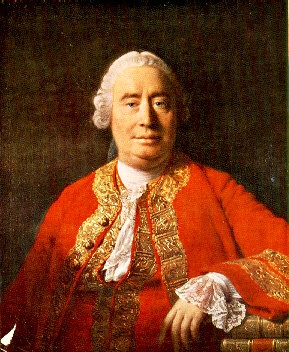 David Hume was a Scottish Philosopher and writer who lived between 1711 and 1776. He generally followed the Empiricist school of thought and was a very sceptical writer.
 His essay ‘An Enquiry Concerning Human Understanding’ was published in 1748 and was probably his most important work, although it was basically just a re-working over of his ‘ A Treatise of Human Nature’ which he had published unsuccessfully around a decade earlier.
Section 1 of ‘An Enquiry’ (which we looked at) was concerned with the ‘Different Species of Philosophy’. This begins with Hume discussing the two different types of ‘moral philosophy’, which is basically the science of human nature.
Hume describes the first school of philosophy by saying that it follows the idea that ‘man was chiefly born for action’ and that we are influenced by our own particular tastes. This is a philosophy much more based on common sense and enters frequently into common life. As it is more obvious and easy to understand this means it is more likely to have an effect on everyday people.
The second manner of philosophy considers man as a reasonable, rather than active being. It suggests that philosophy doesn’t have a fixed answer. Hume states that it is much more ‘abstruse’ and therefore has less of an effect on everyday people and as a result of this the philosopher has a more difficult task of getting his point across – which in turn leads to more mistakes and confusion being created. Hume criticises these philosophers by adding that nature ‘ prohibits’ abstruse philosophy due to the uncertainty it brings and that these types of philosophers often lock themselves away in their thoughts and experience sadness as a result.
Hume suggests that the perfect philosophy is somewhere between the two as an abstruse philosopher is incredibly intelligent but lacks the scientific accuracy needed to clearly understand things. He uses a great phrase to summarize this which is ‘be a philosopher; but amidst all your philosophy, be still a man’.
Hume suggests that the perfect philosophy is somewhere between the two as an abstruse philosopher is incredibly intelligent but lacks the scientific accuracy needed to clearly understand things. He uses a great phrase to summarize this which is ‘be a philosopher; but amidst all your philosophy, be still a man’.
This would suggest that Hume’s ideal philosophy would combine profound ideas with clarity and scientific reason.
Hume, as an empiricist prefers the first school of philosophy as accuracy is more important to him than the ‘beauty’ of abstruse thinking. This is important to us as journalists as we need to be clear and accurate in our writing to produce a short bulletin or ‘News in Brief’ story rather than a 300 page story. Hume considers ordering and reflecting on our experiences as being crucial in how our minds operate and he emphasizes the need to study human nature when he describes that it is just as important to study how our minds work, as it is astronomy.
There is also a brief insight into Hume’s political thoughts in this section when he comments on the need for a politician to have a ‘subdividing and balance of power’ in order to create a stable government. I think that this is very similar to Machiavelli who acknowledged that the people must have some say in an ideal rule, in order to avoid continuous rebellion.
The next section of An Enquiry Concerning Human Understanding focused on The Origin of Ideas and this features the topics which are probably most important to someone studying journalism such as Induction, Causation and how our thoughts and ideas work.
Hume begins with explaining that there is a difference between feeling something (for example pain) and then trying to imagine this sensation again in our mind. He describes how all the colours of poetry can never paint natural objects so that they look like the real thing and states that ‘The most lively thought is still inferior to the dullest sensation’; Suggesting that there is a clear distinction between our experiences and how we view them. His view on epistemology suggests for example that when someone tells us they are in love we use our experience of this emotion to understand what they mean even though it is different and less animated to actually experiencing the feeling yourself.
Hume takes this further by saying that we can divide the perceptions of the mind into two classes which are separated by their different degrees of force or animation.
Hume takes this further by saying that we can divide the perceptions of the mind into two classes which are separated by their different degrees of force or animation.
He calls the less forceful our ‘Thoughts and ideas’ and our more lively perceptions such as hate, love and desire our ‘Impressions’.
When describing our thoughts and ideas Hume says that at first glance nothing seems as unbounded as the thought of man as our imagination can create monsters and unrealistic scenarios. However, Hume says that if you take a closer look at what we imagine you see that we are actually very narrow minded. We create these thoughts very simply by putting familiar objects together. Hume uses the example of a unicorn to show that we conjure up this animal easily by putting virtuous ideas in a horse form. This is an example of synthetic logic where our minds can add knowledge to other knowledge we have and is very similar to Locke’s view on our ideas in that they solely from what we experience.
 However Hume says that there are problems with linking ideas together in our minds as we draw inferences or jump to conclusions using this logic. He says that we tend to produce ideas by induction rather than by reason. To show this he describes Causation theory which is basically where our mind decides that one thing causes another. Two examples of this are the Billiard Ball example where the white ball hits the red and the red moves. We assume that the white ball caused this movement however there is no natural evidence that this happened. The example that Betrand Russell uses is that when biting an apple we may experience a certain taste, but that does not 100% prove that the apple caused the taste.
 Obviously is it highly likely that this is the case and Hume is being extremely sceptical with this idea as it would be pretty much impossible to live without making inferences however, I think that he is correct to scientifically suggest that we should not assume one thing causes another for definite because we regularly find ourselves jumping to conclusions and then realise we were wrong. One example of I could think personally was when I’d brought a magazine from one shop and been accused by a different shop selling the magazine of stealing it from them. Though it would seem likely I had taken it from them, I actually had not.
Finally therefore Hume clearly shows a preference for the ‘Impressions’ of our ideas as these are stronger, more accurate and defined. He says that we should ask ourselves ‘from what impression is that idea derived’ in order to clarify the ideas we have and discard ideas that may not necessarily be true. This is something that Journalists should look to do when reporting a story as it allows us to try to understand exactly what is going on and for what reason rather than drawing inferences between events.
In many ways Hume sees the world as a baby. He sees everything that happens as unusual when broken down and believes that it is all equally improbable. By stating that we should never even assume that the sun will rise tomorrow or any of the other habits of mind we make every day, it is almost like when these things do happen they’re something of miracle. This is an outlook that I feel is a great way to look at things and by not presuming one thing always causes another, we may well notice more unusual ‘miracles’ happen all the time.
Wednesday, 10 November 2010
Confidentiality and Secrecy
Confidentiality is a civil law. This means that it is harmful to an individual as they have a right to keep secrets and pass them on to those they choose to in private – providing of course that the secret is not in the public interest.
Certain professions have a duty not to disclose personal information confided in them, such as Doctors, lawyers and employees etc. Failure to keep such information is therefore a breach of confidence and a claimant has a right to lodge a civil complaint, most likely in a bid for compensation. If information becomes available through a breach of confidence to a Third Party (such as a journalist who may wish to publish such a story) the claimant can apply for an injunction to prevent such an article being published.
Certain professions have a duty not to disclose personal information confided in them, such as Doctors, lawyers and employees etc. Failure to keep such information is therefore a breach of confidence and a claimant has a right to lodge a civil complaint, most likely in a bid for compensation. If information becomes available through a breach of confidence to a Third Party (such as a journalist who may wish to publish such a story) the claimant can apply for an injunction to prevent such an article being published.
Secrecy is a criminal law, including examples such as revealing a military secret without permission and is treated as a much more serious crime. The Official Secrets Act 1911 outlined the duty of confidentiality owed to the UK State and the need to punish those who leak unauthorised information of a sensitive nature. Journalists must be aware of such risks when publishing material concerning the military or information regarding terrorism in particular.
The Official Secrets Act has been accidently broken on a number of occasions. Often a film crew taking a ‘general view’ shot of a military base for example has unintentionally portrayed an area that may disclose private information of use to organisations wishing to harm the UK and this could be considered a crime. To try to prevent this most military bases have large signs forbidding the filming of certain areas in any circumstance. Similarly announcing Armed Forces returns should also be checked before publishing as military location is also considered a government secret.
Businesses also have certain protection rights regarding their commercial activity in The Commercial Confidentiality Statute. For a business to file a claim against someone found guilty of disclosing private information they must prove that the information is important, was imparted in circumstances implying confidentiality, that no permission was given for the information to be published and that the information caused actual detriment.
The Human Rights Act outlines the need for an individual to have a certain degree of privacy in their family life. This often applies to celebrities in particular and it is considered a breach of privacy if photos or videos are published without consent, unless a public duty is being performed.
The are two types of consent; Explicit Consent – which shows an awareness of the camera and Implied Consent – where a person is looking into the camera and posing for it etc.
As a journalistic defence implied consent is generally the stronger defence should a claimant file for a breach of privacy against a photograph being published.
The are two types of consent; Explicit Consent – which shows an awareness of the camera and Implied Consent – where a person is looking into the camera and posing for it etc.
As a journalistic defence implied consent is generally the stronger defence should a claimant file for a breach of privacy against a photograph being published.
Newspaper Surveys
Much of today’s society seems to be obsessed with surveys and polls. This is something that the media has clearly taken on board and we see it in all aspects of news, from opinion and health polls to entertainment and political surveys. Channel 4 even has a long running and successful comedy panel show ‘8 out of 10 cats’ based solely upon strange and unique polls.
Flicking through The Sun on Friday November 5th I found a total of 15 polls and surveys including;
Flicking through The Sun on Friday November 5th I found a total of 15 polls and surveys including;
- 3 out of 4 offenders leaving prison embark on a life in crime
- Car sales fell 22% in October
- More UK men resemble Peter Kay than any other celebrity (according to a phone application – genius!)
- Norway is the world’s best country to live in
- Daily sex with ‘the wife’ is the best way for men to live longer
It seems to me that we shouldn’t take tabloid surveys like this too seriously as many of them didn’t say where the data or sources were acquired. It wouldn’t surprise me if they were simply the product of a Horny Norwegian Criminal Car Salesman who looks like Peter Kay.
Many of these surveys also gave no precise figures or statistics to back up their claims and one ‘fact’ in particular appeared to originate from just one man (no not the Norwegian comedian). Builder Steve Morgan ‘claimed the number of mortgages available to buyers with deposits of ten per cent or less has fallen from 1,244 to just 33 since 2007. This made me wonder just who Steve Morgan was (the boss of Redgrow Housebuilders apparently) and how he had time to interview all those people.
So there we go, I’m not sure I’ll ever take a poll or survey seriously again.
Thursday, 4 November 2010
Studying Newspapers
As part of my Journalism Now topic I am starting to study newspapers themselves and in this blog look at how the different British papers operate and their differing audiences and styles. Peter Cole wrote an interesting series on this in the Guardian and I will link his pages at the bottom.
The sales of newspapers in general are in decline. This may well be to the modern day desire to have everything online, despite this however, over 11.7m papers are bought each day. This figure clearly shows the massive influence that newspapers have on our everyday lives and they can affect everything from how we vote to what we eat and can even form certain prejudices.
Most ‘normal’ people (and by that I mean non- Journalists) read one particular paper. They are often dismissive of other titles despite having never actually read them. What paper we read says a lot about who we are and using Cole’s articles I am going to look at the different papers and try to understand who they are aimed at and how their chosen stories and language affects this; as well as trying to see if papers really are dying and if different titles are evolving and trying to stop this.
Most ‘normal’ people (and by that I mean non- Journalists) read one particular paper. They are often dismissive of other titles despite having never actually read them. What paper we read says a lot about who we are and using Cole’s articles I am going to look at the different papers and try to understand who they are aimed at and how their chosen stories and language affects this; as well as trying to see if papers really are dying and if different titles are evolving and trying to stop this.
The ‘Mid- Market’ (Express and Mail)
The Daily Express is a clear example of a paper who’s circulation is in decline, selling 770,000 papers daily whereas in its peak it topped 4m. It was traditionally a Tory newspaper however during the 1960’s new ownership led to a new Labour preference, though it has recently reverted back. Cole describes its favourite topics to include house prices, taxes, the weather, political correctness, the threat of immigrants and an obsession with Princess Diana (!Express readers look away now! – What was Diana wearing the night she died? A blue bonnet).
The major player in the mid-market section nowadays however is the Daily Mail, which is the second highest selling daily behind The Sun. Cole accredits its success to stable ownership and an understanding of who its reader is. The Mail is very anti liberal, with the majority of its readers over 45 and I would imagine middle class. Cole states that the Mail understands its audiences (probably out dated) prejudices and reflects them socially, culturally and politically.
One way in which I would suggest the Mail is trying to battle newspaper declines is that it spends the highest amount on promotions. It regularly gives away DVD’s and CD’s (although who uses them anymore?) such as The Artist formerly known as Prince’s last CD, to help boost sales. I think that this shows a willingness to battle against decline and evolve and this may well be the reason for it overtaking the Express in the mid-market sales.
The Tabloids
The Daily Express is a clear example of a paper who’s circulation is in decline, selling 770,000 papers daily whereas in its peak it topped 4m. It was traditionally a Tory newspaper however during the 1960’s new ownership led to a new Labour preference, though it has recently reverted back. Cole describes its favourite topics to include house prices, taxes, the weather, political correctness, the threat of immigrants and an obsession with Princess Diana (!Express readers look away now! – What was Diana wearing the night she died? A blue bonnet).
The major player in the mid-market section nowadays however is the Daily Mail, which is the second highest selling daily behind The Sun. Cole accredits its success to stable ownership and an understanding of who its reader is. The Mail is very anti liberal, with the majority of its readers over 45 and I would imagine middle class. Cole states that the Mail understands its audiences (probably out dated) prejudices and reflects them socially, culturally and politically.
One way in which I would suggest the Mail is trying to battle newspaper declines is that it spends the highest amount on promotions. It regularly gives away DVD’s and CD’s (although who uses them anymore?) such as The Artist formerly known as Prince’s last CD, to help boost sales. I think that this shows a willingness to battle against decline and evolve and this may well be the reason for it overtaking the Express in the mid-market sales.
The Tabloids
Tabloid papers are generally considered the papers for the masses. Cole states that they feature quick read stories on crime, sex, sport and celebrities with a mostly working class audience in mind. He adds to though they too are in decline they are something of a loathed obsession for the rest of the media and those who don’t actually read them. The main tabloids of today are owned by two groups The Trinity Mirror (The Mirror and The People) and Rupert Murdoch (The Sun, NOTW). The tabloids aim to connect with ‘ordinary’ people and its main readers are in the skilled manual workers and below social grouping. To meet this demand they have a very low reading age of text and run extensive features on ‘celebrities’ and lower pop culture, the things they seem to think their target audience cares most about. Despite this audience The Mirror in particular under Piers Morgan tried to take a more upmarket approach, no doubt as a result of the falling numbers of the working class population, however this failed, allowing The Sun to increase its stronghold of the tabloids.
Broadsheets
Broadsheets are considered the ‘quality’ newspapers, although Cole suggests this is inaccurate and that ‘serious’ would be a better adjective. The main broadsheets are The Guardian, The Independent, The Times and The Telegraph. Though their circulation is very small they are considered to be of great importance and are the first choice read of most politicians, professionals and managers. As a result of this their style is generally more affluent than that of the tabloids and mid-market papers with a higher reading level and more focus on higher levels of interest and culture.
Broadsheets are considered the ‘quality’ newspapers, although Cole suggests this is inaccurate and that ‘serious’ would be a better adjective. The main broadsheets are The Guardian, The Independent, The Times and The Telegraph. Though their circulation is very small they are considered to be of great importance and are the first choice read of most politicians, professionals and managers. As a result of this their style is generally more affluent than that of the tabloids and mid-market papers with a higher reading level and more focus on higher levels of interest and culture.
It could also be argued that the broadsheets have achieved the most innovation over recent years. The Independent, Times and Guardian all changed to a more compact, tabloid style format of paper with an increase in sales a sign of the success this had. Other examples of change include the magazine supplements that feature in The Times and Guardian in particular, whilst The Times also launched a pay-per-view online format, recently copied by the NOTW, although whether this has been a success is still up for debate. The Telegraph, whilst keeping its broadsheet format, has also moved into the internet age with many interactive features and podcasts.
In conclusion, it is very interesting to try to understand how the different newspapers operate with regards to their audience and attempting to do so certainly changes the way we read and view the differing titles. Change seems to be something that a lot of papers have been reluctant to do but the declining sales suggests that it is something they must attempt. Regardless of this however newspapers are still vital forms of media and are certainly not irrelevant just yet.
For Peter Coles articles see the following links:
http://www.guardian.co.uk/media/2007/aug/20/mondaymediasection.pressandpublishing
http://www.guardian.co.uk/media/2007/aug/20/mondaymediasection.pressandpublishing
Wednesday, 3 November 2010
Joseph Addison
 Joseph Addison was born in May 1672 and could perhaps be considered one of the first true Journalists. The majority of his works focused on minute social observation and his writing style contained much flair and humour.
In 1712 Addison began publishing ‘The Spectator’ with the help of his childhood friend Richard Steele. The Spectator was something of an entertainment paper with articles often featuring the leading fashions at the time as well as frivolous issues such as how to correctly throw a tea party. In many ways the paper was representative of the Restoration period in which Addison worked. This era saw an end to the Puritan reign started by Oliver Cromwell, where plays, parties and enjoyment in general were often seen as immoral. Addison’s style of writing is certainly a step away from this as he uses much humour and colour in his work. There is often something of a sarcastic tone to his style such as when describing the Royal Exchange in one essay he comments that there were ‘tears that have stolen down my cheeks’. This over-exaggeration is a clear example of the gentlemanly style of tongue-in-cheek wit that was fashionable at the time.
Another interesting aspect of Addison’s work, particularly The Spectator, was that it was aimed at both male and female audiences. Many articles focused on what was fashionable at the time and this shows that Addison clearly understood he had female readers as well. This was very reflective of the age as the increasing industrialisation had led to a rise in the middle class and therefore it was considered very proper for domestic women to spend their growing leisure time sat around a table cheerfully discussing papers like The Spectator. Addison himself acknowledges the value of female writers in his piece ‘On the Essay form’ commenting that he received letters from ‘persons of the best sense in both sexes’. This is yet another example of a change in attitude in the Restoration period as during Puritan times women were somewhat distrusted and witch hunts were still prevalent – no doubt with Eve and the apple firmly in mind!
Method writing is described as being a ‘plantation’ where everything is laid out and planned in a certain order, making what is being written clear and easy for the reader to comprehend. He also believes that this style is effective in conversation and debate as it prevents losing sight of the question, as well as helping the author come to terms with their ‘invention’.
In contrast to this lengthy ‘essay’ writing is portrayed as a ‘great wood’ full of ‘noble objects and confusion’. Addison praises the writing of a single volume of ones work but suggests that many great pieces have perhaps been lost due to writers being unwilling or unable to construct such a large amount of work. He likens this style to throwing down ‘Pearls in heaps’ in front of the reader rather than the ‘pains of stringing them’ and this would suggest that though Addison saw the genius in long volumes of work, he preferred shorter, concise pieces.
To press this point further Addison used two characters to describe each form – Tom Puzzle and Will Dry. This humorous method was often used by Addison for entertainment purposes and also to help emphasize his points of view. Tom Puzzle represents the Unmethodical style of writing, with Addison stating that he knows enough to ‘raise doubts but not to clear them’. This suggests a person that knows a lot about a handful of subjects but has no concise knowledge and therefore has to revert off topic in conversation. In contrast Will Dry’s character is a ‘clear, methodical head’ that uses less words but has an advantage of Puzzle and cuts him short with precise questions.
Such characters help to show Addison’s own views and opinions. Puzzle and Dry appear to depict Addison’s own preference for methodical writing of short, lively pieces and these are common in the work of the press, which is a great way of dealing out ‘lectures’ to the public. Addison himself stated that he wished the great writers before him had had such an invention as it would have made their own works much more concise.
This perhaps best shows Addison’s importance to journalism as a profession. As well as understanding its potential as a business, The Spectator in particular was vital in bringing philosophy, information and stories into everyday life via the press, as previously it had only really been used as propaganda for religion and political parties. His love of precise, entertaining articles is also something that should be adhered to by any good journalist.
Subscribe to:
Posts (Atom)